Security // Article
What Recent Cybersecurity Incidents Have in Common
A report-based review of recurring failure patterns across telecom, SaaS, enterprise software, source-code, and package-supply-chain incidents.
Security incidents rarely share one exploit, but they often share the same enabling conditions. A review of incidents documented between April 2025 and March 2026 points to recurring weaknesses in access control, patching, third-party oversight, release engineering, and detection.
This article condenses the supplied incident report. It does not independently verify or extend the report’s claims; disputed or unconfirmed details are identified as such.
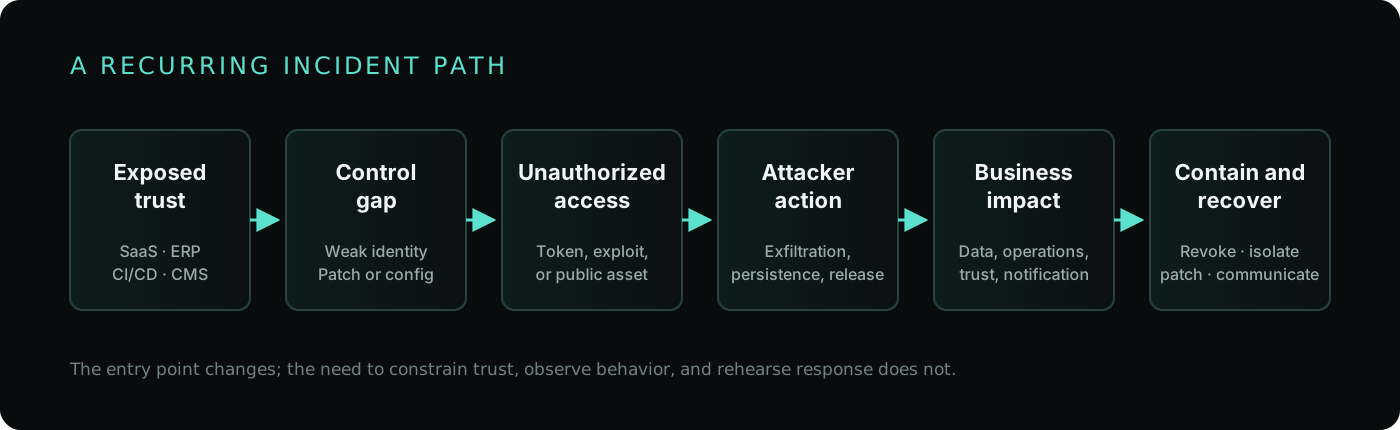
Across the reviewed cases, different entry points repeatedly led through a control gap to unauthorized access, impact, and a containment-and-recovery cycle.
Five recurring failure patterns
Basic controls still decide the impact
The SK Telecom case is the clearest example in the report. Investigators found outdated systems, weak administrative credential practices, and unencrypted data alongside BPFDoor infections. Approximately 26.96 million subscriber identity records were reported exposed.
The technical lesson is not novel, which is precisely why it matters: patching, administrative authentication, and encryption are foundational controls. Advanced detection cannot compensate indefinitely for their absence.
Third-party platforms expand the real perimeter
The Qantas and Allianz Life incidents were described as compromises of third-party Salesforce-based environments rather than the organizations’ core systems. Qantas reported contact and frequent-flyer data for roughly five million customers; Allianz reported approximately 1.5 million customers, brokers, and employees affected.
Keeping a core network untouched does not make a third-party breach minor. SaaS applications hold production data, accept privileged tokens, and often connect to multiple internal workflows. They need the same treatment as first-party infrastructure:
- phishing-resistant MFA for administrators;
- short-lived and narrowly scoped integration tokens;
- IP and device restrictions where practical;
- centralized audit logs and anomaly detection;
- rehearsed token revocation and customer-notification procedures.
Enterprise applications remain high-value targets
The report describes exploitation of Oracle E-Business Suite vulnerability CVE-2025-61882, including SSRF and XSL-related techniques used to reach remote code execution. Attackers reportedly established persistence and exfiltrated enterprise data before emergency fixes became available.
For exposed ERP systems, patching is only one layer. Defenders also need attack-surface reduction, segmentation, virtual patching, and retrospective log review for known exploit patterns. When a zero-day is already active, waiting for a normal maintenance window is a risk decision, not a neutral default.
Sensitive material leaks through ordinary workflows
Not every damaging disclosure begins with an intrusion. Two Anthropic cases in the report involve operational mistakes: a CMS configuration that exposed internal assets and a source map included in an npm release that revealed Claude Code source.
The common control is secure-by-default publishing:
- Keep unpublished assets private unless explicitly approved.
- Inspect release artifacts, not only source repositories.
- Fail builds when source maps, credentials, internal URLs, or unexpected files appear.
- Treat package manifests and generated archives as security boundaries.
Once an artifact reaches a public registry, deletion cannot reliably undo distribution.
The software supply chain concentrates risk
The report’s Axios case describes two malicious npm releases, 1.14.1 and 0.30.4, published after a CI/CD identity compromise. The backdoored versions introduced a package that selected platform-specific payloads.
Whether the exposure window lasts hours or weeks, a popular dependency can deliver attacker-controlled code directly to developer machines and build environments. Useful safeguards include ephemeral publishing credentials, protected release environments, human approval for public releases, provenance verification, dependency-change monitoring, and endpoint detection on developer workstations.
Claims and uncertainty matter
The Mailchimp section demonstrates a different incident-response problem: an extortion group claimed a large breach, while Intuit reported finding no evidence that Mailchimp systems had been compromised. The report treats the available sample as limited and the broader claim as unconfirmed.
Security communication should preserve that uncertainty. A claim, an observed artifact, and a confirmed compromise are three different confidence levels. Collapsing them into one headline creates poor decisions and unnecessary harm.
A practical defensive model
The cases converge on a short control loop:
Reduce exposure
      ↓
Harden identities and integrations
      ↓
Collect endpoint, network, cloud, and release telemetry
      ↓
Detect and contain abnormal behavior
      ↓
Rotate, patch, recover, and communicate
      ↓
Feed lessons back into engineering
This loop applies across telecom infrastructure, SaaS integrations, enterprise applications, internal content systems, and open-source publishing.
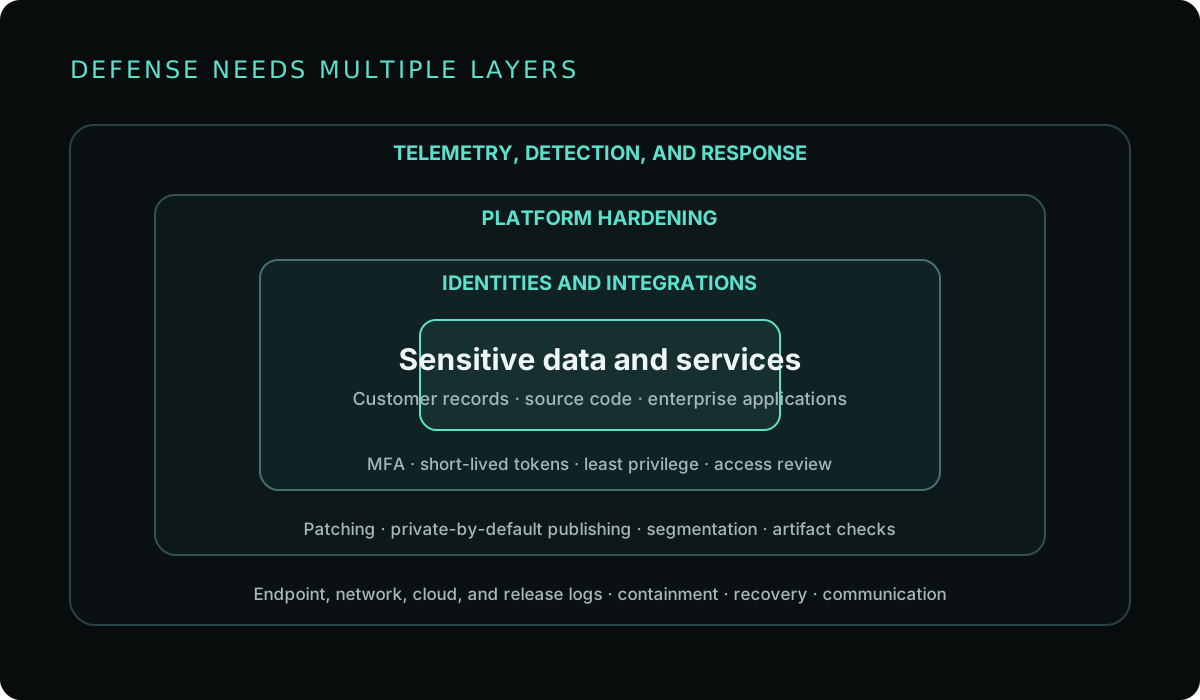
No single control covers the reviewed failure modes; identities, platform hardening, telemetry, and response reinforce one another.
Lessons for security teams
- Assume credentials will leak. Enforce MFA, prevent reuse, and monitor for abnormal access rather than relying on password secrecy.
- Inventory third-party trust. Know which vendors hold sensitive data and which tokens can reach internal systems.
- Segment high-value platforms. ERP, source-control, build, and publishing systems should not offer unrestricted paths to the rest of the environment.
- Inspect outbound behavior. Unusual egress helped surface the SK Telecom compromise and is equally valuable for malware and data-exfiltration detection.
- Secure the release path. Generated packages, source maps, CI identities, and registry permissions deserve explicit controls.
- Prepare the nontechnical response. Notification, legal review, customer support, and evidence preservation should already have owners before an incident.
- State confidence precisely. Separate attacker claims from verified findings and document what remains unknown.
The consistent message is that resilience comes from layered, repeatable controls. Strong identities, timely remediation, constrained trust, useful telemetry, and rehearsed response reduce the chance that one overlooked weakness becomes an organization-wide crisis.