Cybersecurity // Completed
WannaCry Malware Analysis
Static and dynamic analysis of a WannaCry sample in an isolated Windows environment, with correlated process, file, registry, and network evidence.
Overview
This analysis examined a WannaCry sample with static inspection and interactive sandbox observation. The work focused on what the binary appeared capable of, which behaviors were observed at runtime, and how those findings translate into defensible detection and response actions.
SHA-256: ed01ebfbc9eb5bbea545af4d01bf5f1071661840480439c6e5babe8e080e41aa
Target: Windows 10 Professional, build 19044, 64-bit
Objectives
- Identify meaningful strings, imports, and other static indicators.
- Observe the process tree, filesystem changes, registry activity, and network behavior.
- Correlate static capabilities with runtime evidence.
- Produce detection, containment, eradication, and recovery actions grounded in the observed sample.
Environment and architecture
The local target was a Windows 10 guest in VirtualBox with a host-only adapter to prevent access to the physical host or external network. A clean snapshot and Regshot baseline were created before execution.
ANY.RUN supplied the interactive analysis environment used to trigger components and observe secondary payloads. The report also records FakeNet-NG for simulated network responses, ProcMon for high-frequency system calls, and Process Explorer for the live process tree.
Sample
  ├── static inspection ──> imports, strings, timestamp, entropy
  └── isolated execution
        ├── process and file activity
        ├── registry persistence
        └── simulated network observation
Tools
- Binary Ninja: disassembly, strings, cryptographic imports, and the import table
- ProcMon: system calls and file-permission changes
- Process Explorer: parent-child process relationships
- FakeNet-NG: simulated DNS and HTTP services
- ANY.RUN: interactive execution and consolidated telemetry
- Regshot: pre-execution system baseline
Implementation
Static analysis was performed before execution. The binary carried a 2010-11-20 09:05:05 timestamp, which the report treats as inconsistent with the 2017 WannaCry lineage, and contained high-entropy sections suggestive of packing. Imports included CryptGenKey, CryptDecrypt, and CryptEncrypt.
Hardcoded strings exposed preparation commands:
icacls . /grant Everyone:F /T /C /Q
attrib +h .
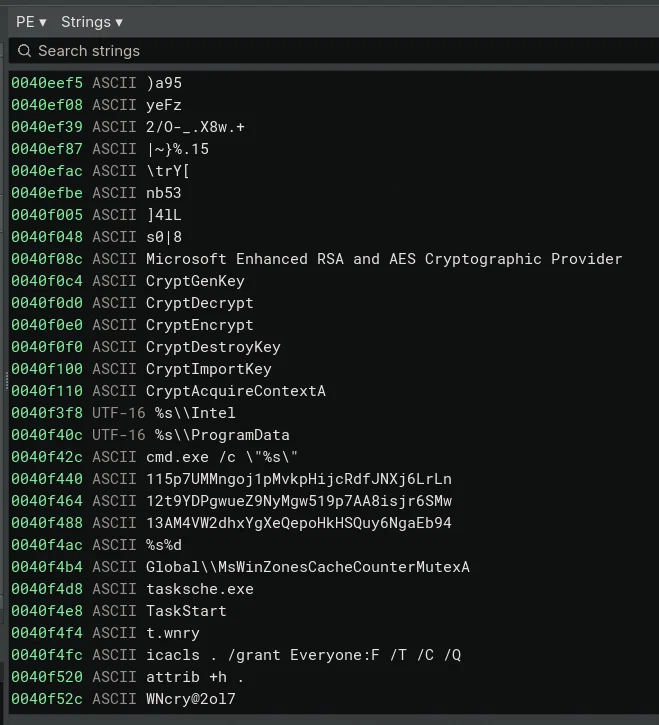
Static inspection exposed CryptoAPI functions, the Microsoft cryptographic provider, task utilities, and the embedded icacls command.
The first recursively grants full access to files in the current directory; the second hides the working directory. The string Global\\MsWinZonesCacheCounterMutexA was identified as an infection marker intended to prevent repeat execution on the same host.
The sample was then run interactively. The main payload launched cmd.exe, multiple @[email protected] instances, cleanup utilities, and registry tooling. Runtime evidence was compared with the earlier static findings.
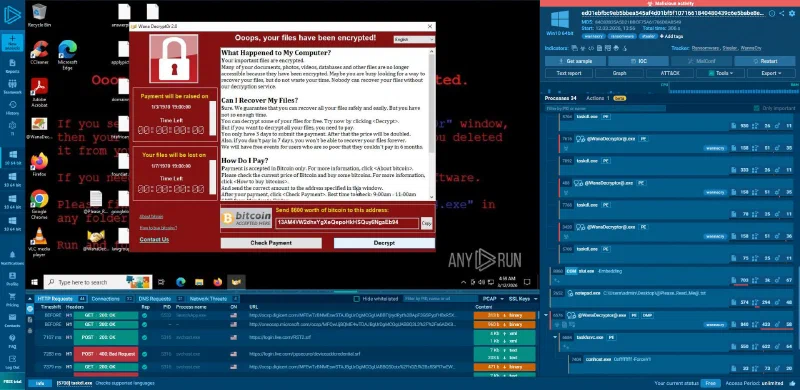
The interactive sandbox captured the ransom interface alongside the process list and network telemetry.
Findings
Process execution
The report recorded this execution chain:
- The main sample started as PID
7596. - It spawned
cmd.exeas PID4564for hidden batch commands. - Multiple
@[email protected]processes ran under PIDs6576,2692, and6064. taskdl.exeran as PID3340for cleanup.reg.exeran as PID6228and modified Autorun values.
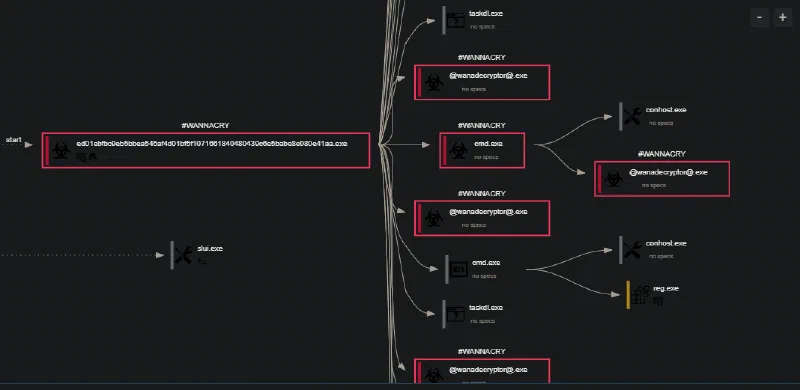
The process graph connects the initial sample to @[email protected], cmd.exe, conhost.exe, and cleanup activity.
Files and persistence
The sample used the temporary directory to stage .wnry components. The report also records writes to the Word startup and Chrome extension directories, plus Autorun changes intended to relaunch ransomware components after reboot.
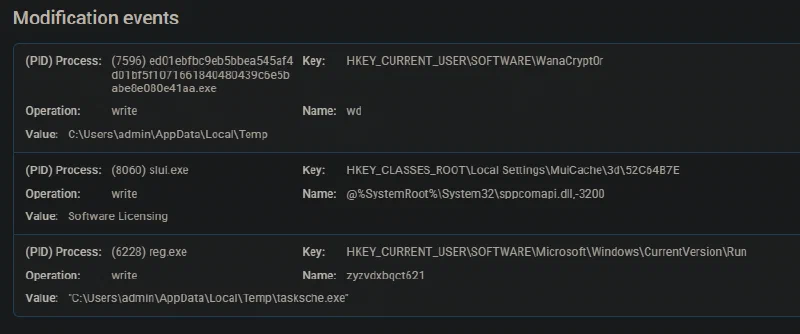
Runtime telemetry captured a WannaCryptor value and a CurrentVersion\Run entry pointing to tasksche.exe.
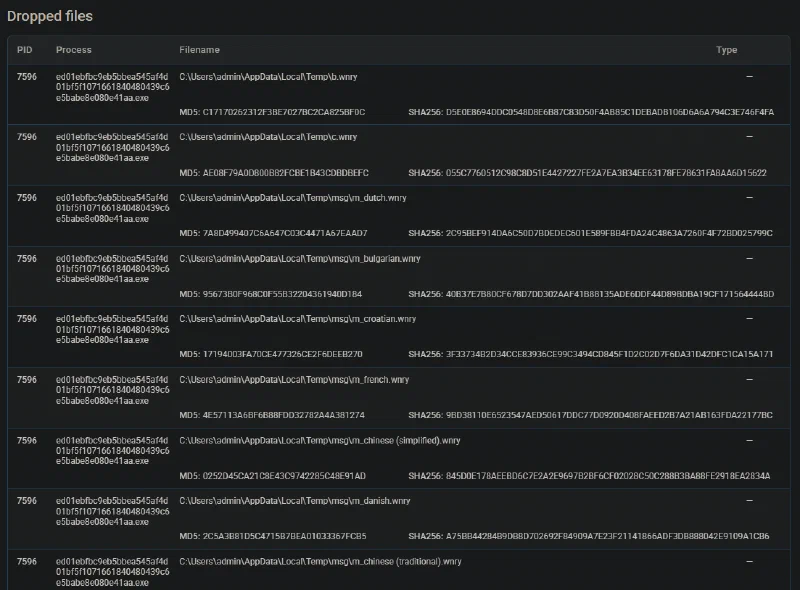
The dropped-files view records .wnry components and supporting executables created during the session.
Network behavior
The sandbox showed indicators of Tor use. The report interprets this activity as infrastructure intended to obscure command-and-control destinations; it does not document a confirmed external controller reached from the isolated local VM.
Static-to-dynamic correlation
| Static evidence | Runtime evidence | Supported conclusion |
|---|---|---|
icacls command string | The main process called icacls.exe | The sample changed file permissions |
| CryptoAPI imports | Large-scale creation of .wnry files | Cryptographic capability aligned with ransomware file activity |
| Task and persistence strings | Autorun values were added | Persistence behavior occurred at runtime |
Challenges
- Ransomware execution required strict separation from the host and a reliable rollback point.
- Packed or high-entropy sections limited what static analysis alone could establish.
- Simulated connectivity reveals attempted behavior but does not prove that a real command-and-control endpoint was contacted.
- Process names vary between the narrative and screenshots, making behavior and hashes stronger identifiers than filenames alone.
Results
The exercise connected static indicators to observed process, registry, file, and network behavior. It confirmed permission changes, ransomware component execution, .wnry staging, and persistence-related registry activity within the analysis environment.
The report does not claim successful decryption, recovered user data, or measurement of propagation across multiple hosts.
Lessons learned
- Static strings become substantially more useful when tied to a runtime event.
- Process ancestry and command-line monitoring can surface ransomware preparation before encryption is complete.
- Creation of
.wnryfiles and unusualicacls /grant Everyone:Factivity are practical detection opportunities for this sample. - Containment should isolate the affected VLAN or host and disable SMBv1 to reduce the family’s known lateral-movement path.
- Recovery should rely on a clean reimage and offline backups, not the ransomware’s bundled decryptor.